Websites for Brisbane excavator and plant hire
A hire website that answers the one question that matters (will this machine do my job?) and puts the owner's phone number in front of it.
What your customers are actually doing
- Most callers do not know whether their job even needs the machine they are ringing about
- Access is the deciding factor, and they will not think to mention it
- They are checking availability for a specific week, not browsing
- Out of town, getting the owner on the phone is the thing they actually want
So the site has to
- Full specs where they can be read, not in a downloadable PDF
- The one number that decides the job, said in words
- A "what people hire it for" list that turns away bad-fit work
- Attachments listed, so the right ones go on the trailer
- The owner's phone number as the primary button on every screen
The problem with most hire websites
Most exist so that nobody has to pick up the phone. For a small operator, that is exactly backwards.
When there is one machine, whether it is free next Tuesday depends on where it is this Tuesday and how long that job runs over. Access, gateways and slopes decide which attachments go on the trailer. A booking system will cheerfully take a deposit for a job the machine physically cannot reach, and then the owner loses a day driving out to say so.
So the Matches Machinery Hire site has no cart, no account and no online deposit, and it says so outright: no call centre, no booking system, you speak to the person who owns the machine. For a hire business well out of town, that is what people want.
The specs are the content
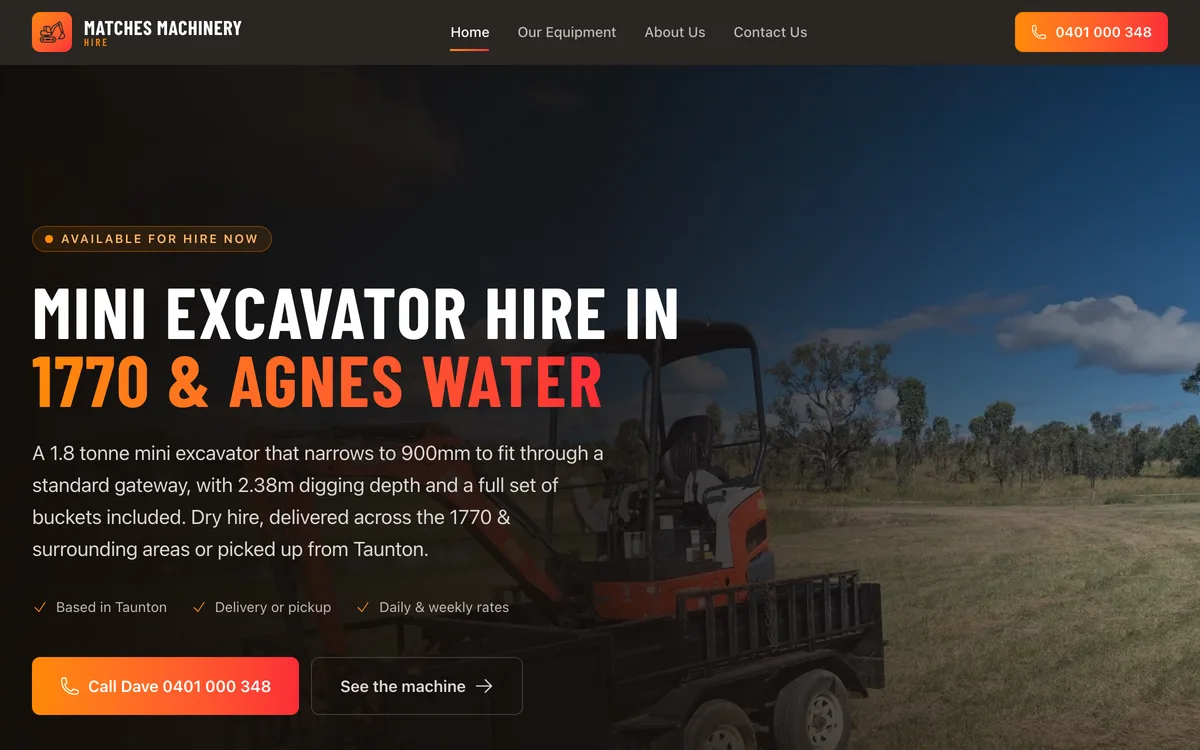
Weight, track width and dig depth run in the hero and again on the machine page. But the numbers alone are not enough, because most of the people reading them cannot do anything with them.
One spec usually decides the job, and the copy should say what it means. On the Matches machine it is the track width: 990 mm retracting to 900 mm. That is the difference between getting through a standard side gate and not getting through at all. So the hero says that in words rather than leaving people to do the arithmetic.
Everything else belongs on the machine page in full: engine, breakout force, digging depth, what is included in the hire, what costs extra. None of it belongs in a PDF nobody downloads.
Turn away the wrong jobs on purpose
The single most useful section on a hire site is a plain list of what people hire the machine for: trenching for water, power and drainage, footings, post and pier holes, backyard access, site clean-up and rock breaking.
Most people hiring an excavator do not know whether their job even needs one, so the page answers the question they really have: will this machine do my job? Then it invites them to describe the job and promises a straight answer if it is the wrong machine.
That sounds like turning away business, but what it turns away is a wasted delivery, which costs a day. The owner gets fewer calls, and better-qualified ones.
Set the expectations before the trailer is loaded
Three steps: call or enquire, confirm dates and delivery, machine arrives. The section exists to establish that this is dry hire and the customer supplies the operator, and to prompt them to mention augers or the rock breaker before anything gets loaded.
The phone number is the primary button in the header, the hero and the footer. The enquiry form sits behind it for after hours, not in front of it.
The job behind this page
Every claim above comes from a site that is live right now. Here is the write-up, including the parts that are still on the to-do list.
What does it cost?
The prices are on the site, which is more than most will tell you before a sales call. One-page sites start at $990 and a full multi-page site at $2,490, with a single fixed quote agreed before any work starts.
See the pricingTell me about the job
What you do, where you work, and what you need the site to bring in. Free quote, honest advice about whether excavator & plant hire is a good fit for me, and a reply within one business day.
Get a free quote